Cache is one of Counter-Strike's most legendary maps. Set in the Chernobyl exclusion zone in Ukraine, it's been a community favourite since its CS:Source days — and with Valve having acquired the CS2 version of the map from creator FMPONE. On April 29, 2026, Valve dropped a 5.1 GB update and officially returned one of Counter-Strike's most iconic maps to CS2 — fully rebuilt for the Source 2 engine after seven years away from the competitive map pool. The wait is over.
If you're a returning player who hasn't touched Cache since 2019, or a newer player experiencing it for the first time, this guide covers every named location on the map, what visually changed in Valve's rework, what stayed the same, and how it all fits into real rounds.
What Are Callouts and Why Do They Matter on Cache?
Callouts are the shared vocabulary of CS2 — agreed-upon names for specific spots on a map that let teammates communicate enemy locations, coordinate pushes, and call rotations in a fraction of the time it would take to describe them.
Cache makes callouts especially critical. It's a fast map by design. Rotations between sites happen in seconds, and mid control can instantly shift the balance of a round. When you say "two A Main, one Squeaky" your team knows exactly what's coming and can counter it before the rush arrives.
Cache is relentlessly fast: rotations are instant, and fights are often brutal, with rapid firefights where hesitation is a death sentence. When you call the right spot name, your teammates can position, trade, and throw utility with a plan instead of guessing.
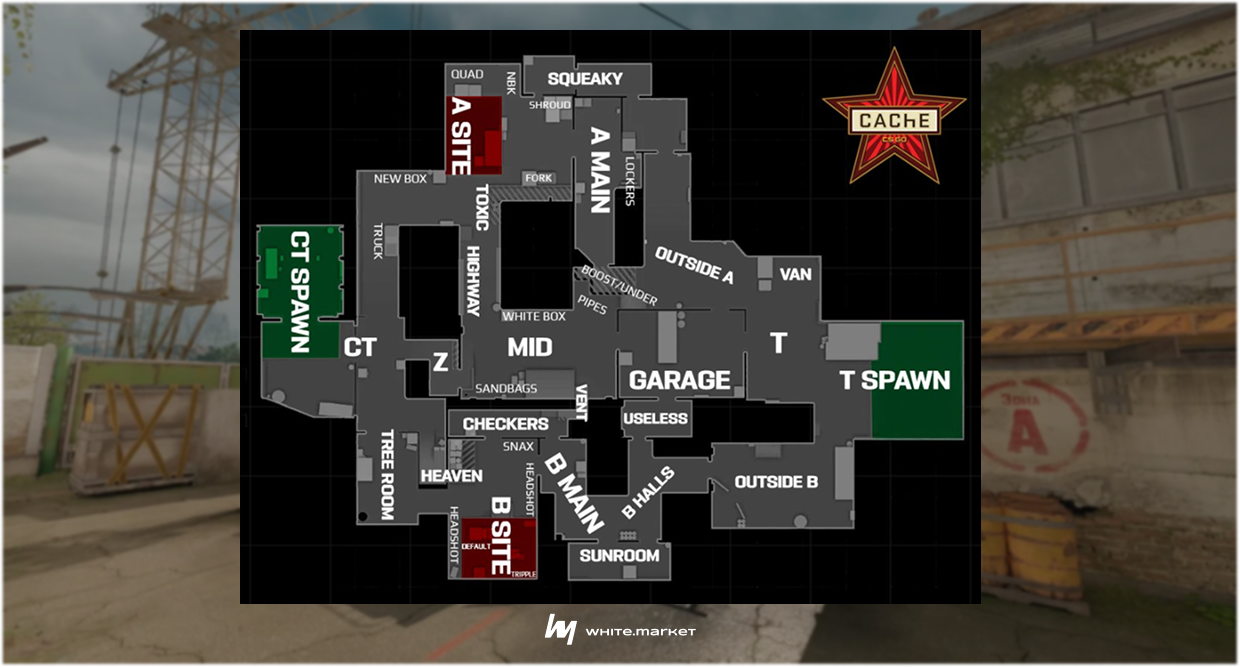
Cache Map Overview: The Three Zones
Before diving into individual callouts, it helps to understand Cache's structure. The map divides cleanly into three functional zones:
A Site zone — accessed primarily via A Main (the long T-side corridor) or Squeaky (the door room). CTs defend from Quad, Forklift, and Balcony.
B Site zone — reached through B Main/B Halls and flanked by the Sun Room and Heaven. More enclosed than A, with tighter angles.
Mid — the central zone linking both sites. Control of Mid is often what determines which team wins the round, as it enables splits and cuts off rotations.
All CS2 Cache Callouts — A Site
A Site is Cache's more open bombsite. Lots of wide angles, a dominant high-ground position (Balcony), and a secondary door entry that can be faked or rushed.
A Main
The primary Terrorist entry route to A Site. A wide corridor lined with crates that leads directly to the site. CT-side players may hold angles from Quad, Forklift, or Catwalk. Most A-site rounds start here.
Squeaky
A small room with a distinctive squeaky door that opens onto A Site from the T side. Squeaky refers to both the door itself and the small room behind it. Players often pre-nade or molly Squeaky to deny entry. It's frequently used for fast pushes or as a fake while pressure builds in A Main.
Quad
A big set of boxes located at the back of A Site. One of the most common CT anchor positions on A — a player holding Quad has sight lines onto both A Main and Squeaky entries. Also a common default plant spot for Ts.
Forklift
Named after the yellow forklift props near the site entrance. Forklift offers strong angles onto A Main and is a classic CT hold. AWPers frequently set up here at the start of rounds.
Default (A Site)
The main set of crates located in the middle of A Site. When players say "default plant," this is where the bomb goes. A key reference point for all site-play communication.
NBK
A tight corner between A Main and Quad, named after CS:GO pro player NBK. A sneaky off-angle that catches pushers off guard. More relevant in pro play but worth knowing.
Balcony
An elevated walkway overlooking A Site, accessible via the Ladder from Highway. Players can be boosted onto Lamp, a position alongside the side wall of A Site, so watch out for unexpected vertical angles.
Shroud Boost
A famous boost spot on the CT side of A Site that lets a player gain an unexpected elevated angle on T entries. Named after pro player Michael "shroud" Grzesiek. CTs can use the balcony and the shroud boost spot to gain beneficial angles on A Main.
Ebox
An electrical box parallel with New Box, leading onto A Site from CT Spawn. A piece of cover on the CT rotation path that often becomes relevant during retakes.
Ebox / New Box
Two pieces of cover on the CT rotation path leading onto A Site. Used during retakes and as position references when calling CT locations.
Truck (CT Side)
A large truck near the CT side of A Site with a direct
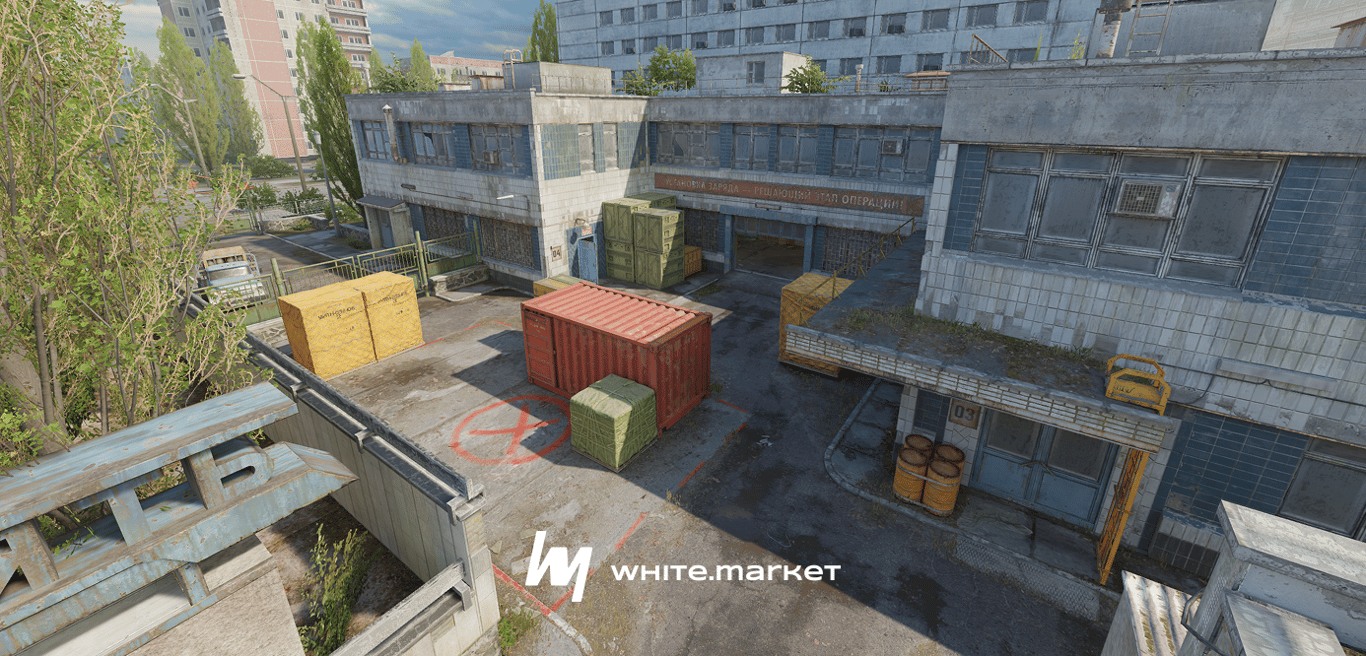
All CS2 Cache Callouts — B Site
B Site is tighter and more layered than A. Multiple rooms feed into it, and the Heaven position gives CTs a strong elevated anchor.
B Main
The room Terrorists pass through immediately before entering B Site. The final chokepoint on the B approach — calling "B Main" means the attack is imminent.
B Halls
The room directly in front of the Dumpster, opposite the Garage, with a direct route from T Spawn. The primary B-side movement corridor for Terrorists early in the round.
Checkers
A key area on B Site named after a checkerboard-style floor pattern. Positioned near the Vent entry from Mid and used as both a plant zone and a contested angle during site defence. Mid control via Vents opens Checkers.
Heaven
A ramp leading up to Rafters from CT Halls. An elevated CT position that overlooks B Site and provides strong crossfire angles. CTs often rotate into Heaven to defend B or retake. It's also a powerful AWP position, though vulnerable to molotovs and flashes.
Sun Room
A room with the sun painted on one wall, connecting B Halls. Terrorists pass through here when navigating toward B Main. Also hosts a window for throwing grenades into B Site.
Flash Window
A window where players can throw grenades into B Site from the Sun Room. Used for flashing the site before a B push — one of the standard grenade spots on Cache.
Toxic / Toxic Barrels
A set of barrels near B Site with a distinct visual. Used as a plant reference and a cover position. "Toxic plant" refers to placing the bomb behind these barrels for a trickier defuse angle.
Default (B Site)
The standard plant spot behind the tall boxes at the back of B Site. The most commonly used bomb position on B in default setups.
Headshot
A position where a player can peek with only their head visible. Most relevant to B Site holds, where a CT can peek dangerously with minimal body exposure.
Quad Stack (B)
A group of boxes Ts can plant around or CTs can use to surprise attackers. Distinct from A Site's Quad — refers to a different box formation on B.
Generator
A named area near B Site. Useful as a landmark for mid-round communication about CT positions or bomb planting zones.
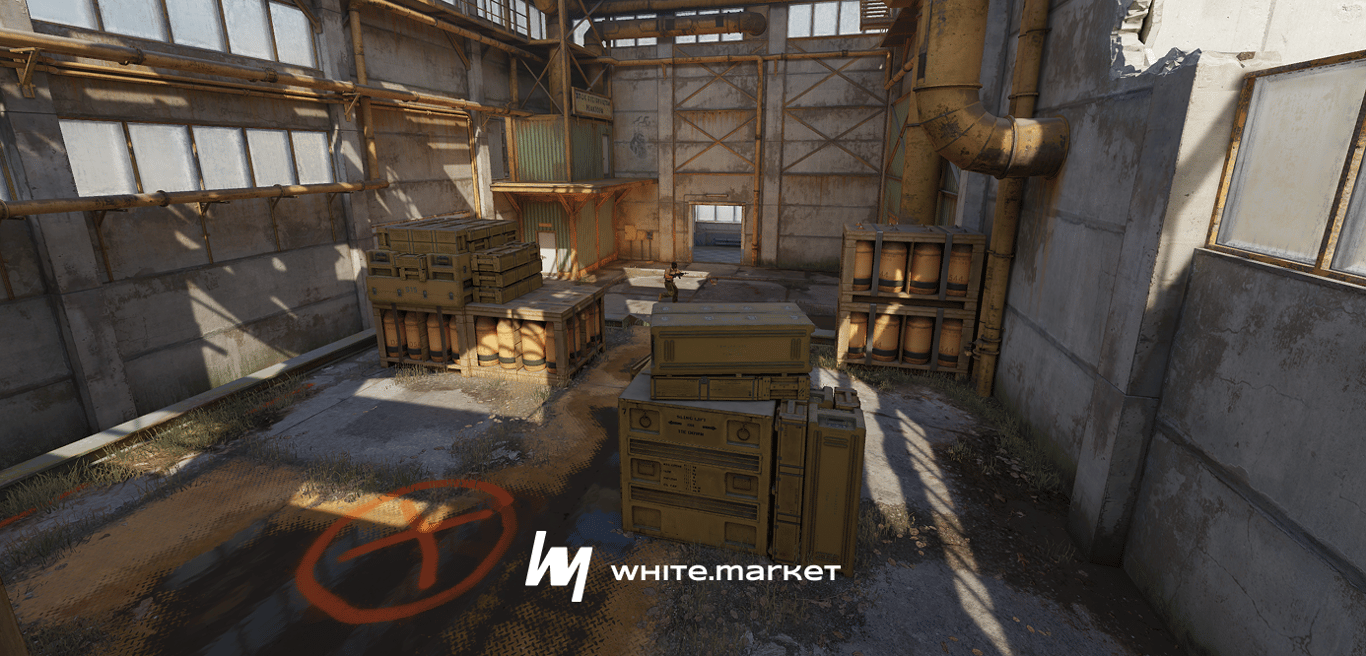
All CS2 Cache Callouts — Mid
Mid is the control valve of Cache. If you hold Mid, your team gains information, faster rotations, and the ability to split either site without walking blind into stacks. Every key Mid callout matters from round one.
Garage
A large garage area directly in front of T Spawn. T-side players funnel through Garage on their way to Mid. Also a common smoke/flash target to deny CT info.
T Red / Red
A red container position inside Garage used for picks and info. Aggressive Ts can peek from Red to gain early information on CT rotations through Mid.
Dumpster
A room opposite Red connecting the Garage to a path toward B Site. Primarily a T-side transition space.
White Box
A common reference cover point near the Mid/Highway end. White Box refers to the region surrounding and on top of the large white box at the end of Highway (mid-side), often used to peek Garage by CTs.
Highway
A short ramp leading up to A Site from Mid. Highway connects Mid (via the boost or Mid Box) to A Site. It's often used by rotating CTs or Ts gaining Mid control. A Highway lurk is a common T tactic to flank A from behind.
Sandbags
Sits at the beginning of Highway and is a common CT hold — a key part of Cache's Mid control. Sandbags denotes the area surrounding and atop the sandbags positioned between Connector and Mid Roof.
Mid Roof
The roof area near Vents and Sandbags, used for vertical control and information. A player on Mid Roof can see across multiple entry angles. Risky to hold but powerful when it works.
Boost
A boostable spot that creates unexpected vertical angles into Mid. Typically requires a teammate to boost, but opens sightlines that opponents rarely expect.
Cubby
A tucked corner near the A Main side used for hiding and close fights. Cubby is the corner directly beneath Boost, next to A Main. A common hiding spot for CTs making unexpected plays.
Vents
Vents refer to the vicinity surrounding and within the vents connecting Mid to B Checkers. Controlling Vents from Mid is how Ts split B Site from both Main and the flank.
CT Connector / Connector
The CT-side connector room used for control and AWP lines. Connector links Mid to CT Hall/CT Spawn and is often frequented by AWPers on the CT side at the round's start.
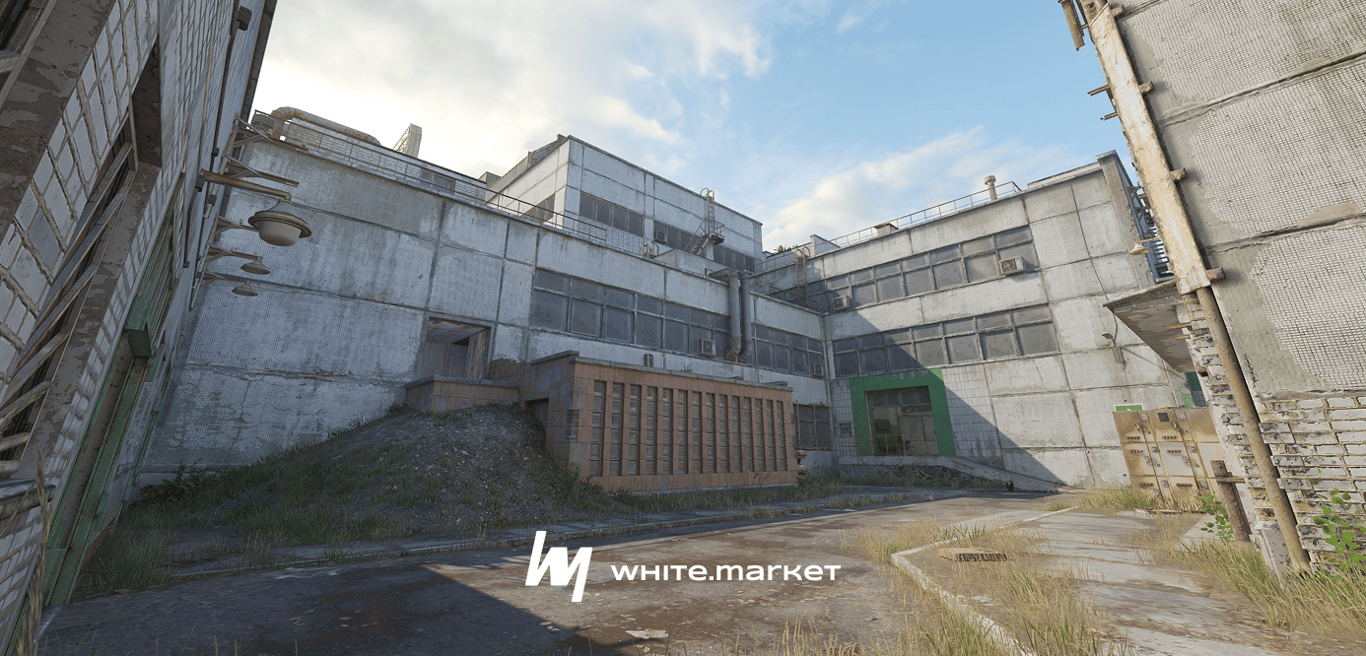
All CS2 Cache Callouts — Spawn Areas & Rotation Paths
These callouts come up constantly during rotates, saves, and second-half setups.
CT Spawn
The area where CTs spawn at the start of every round. Connects directly to CT Halls, Heaven, and Mid. Communication about rotations often references CT Spawn as a starting or passing point.
CT Halls
CT Halls refers to the expansive area between Truck and Hell, distinguishable by its size relative to other callouts on the map. The main artery for CT rotations between sites.
T Spawn
The round begins here for the Terrorist side. From T Spawn, players can branch toward A Main, Mid, or B Halls. Communication often starts here as players call the default plan.
T Boxes
A wide open area beyond T Spawn when heading to B. No actual boxes — just the name.
Outside A / Long A
The open area where players choose to head to A Main or A Long. Called during early-round reads when watching for a split.
Hell
The main open area leading to B Site from CT Spawn. A key reference for CT-side rotations and for calling flanks.
Truck (T Side)
A large truck located just beyond T Spawn when heading towards A. Distinct from the CT-side Truck near A Site — always specify side when calling Truck.
Z Connector / Lockers
A rotation path connecting Mid to B. Used by CTs making a fast rotate and by Ts attempting a late-round flank.
Cache Callout Quick-Reference List
For bookmarking and use as a cheat sheet:
T-Side / Approaches T Spawn · T Boxes · Garage · T Red · Dumpster · Outside A · A Main · Squeaky · B Halls · Sun Room · Flash Window · B Main
Mid Mid · White Box · Highway · Sandbags · Boost · Cubby · Vents · Mid Roof · Garage · CT Connector
A Site A Site · Default · Quad · Forklift · NBK · Ebox · New Box · Balcony · Ladder · Lamp · Shroud Boost · Truck (CT) · Backsite
B Site B Site · Default · Checkers · Heaven · Rafters · Sun Room · Toxic · Headshot · Quad Stack · Generator · Back Site
CT Side CT Spawn · CT Halls · Connector · Hell · Wood · Tree · Heaven · Truck (CT) · Lockers
Cache Strategies: How to Use Callouts in Real Rounds
Knowing the names is step one. Knowing when to call them is what actually wins rounds.
Mid Control as T — The Enabler Play
Occupation of Mid gives Terrorists options to split either bombsite and forces Counter-Terrorists to waste utility early. A common T-side approach: smoke Garage, push White Box, take Vents control — now you can split B from Main and Checkers simultaneously, and the CT rotation has to choose a side without information.
A Site Execute
Standard smokes hit Forklift, Balcony, and CT Halls. Flashes cover A Main entry. One player pushes Squeaky simultaneously to divide defensive attention. The Quad stack becomes the default plant for a short defuse timer.
B Site Execute
Smokes cover Heaven and CT rotation from Connector. Flash Window grenade from Sun Room blinds site defenders. Two players hit B Main together, one takes Default plant, one watches Heaven.
CT Information Loop
The most important habit for CT players: after every kill or information peek, call it out immediately. "One dead A Main, one still Squeaky" is the difference between a coordinated retake and four CTs walking into separate angles.
How to Learn Cache Callouts Fast
1. Play offline with bot_kick enabled Load Cache in a practice server (or via Workshop), kick all bots, and walk every area of the map while calling the name out loud. The muscle memory of movement + name locks the association in faster than reading alone.
2. Use a callout cheat sheet for your first few sessions Keep this guide open as a secondary window. After every death or rotation, check what area you were in and confirm the name. Within 3–5 sessions, the main callouts become automatic.
3. Focus on the 15 most-used spots first You don't need all 50+ callouts immediately. Master these first: A Main, Squeaky, Quad, Forklift, B Main, Checkers, Heaven, Mid, White Box, Highway, Sandbags, Vents, CT Halls, T Spawn, Garage. These cover 90% of in-game communication.
4. Watch Cache demos or pro games Listening to how experienced players call positions in real time ingrains the vocabulary faster than any list. Pro matches, coaching videos, and streamer footage all work.
Is Cache Coming Back to CS2 Competitive?
Cache left the official CS:GO competitive map pool in 2019 but returned as a workshop remake for CS2 in March 2025, with potential for official competitive reintegration. Valve purchased the CS2 version of Cache from creator FMPONE, giving the developer full control over the map.
Cache was in development and released at the end of April 2026. Previously, Cache was mainly played via Workshop and custom servers. It's also already available on FACEIT, so ranked Cache matches are happening now.
The bottom line: if you're going to put time into learning a map in 2026, Cache is one of the highest-value investments you can make. The callouts from CS:GO carry over completely, and learning them now means you won't be caught flat-footed when Valve adds them back officially.
Upgrade Your Inventory for Cache's Return
With Cache coming back, there is a reason to actually care what your loadout looks like. There's a certain satisfaction in winning a clutch on A Site with a skin you love, and Cache is exactly the kind of map that makes those moments feel even better.
If you're looking to refresh your inventory before Cache hits the official rotation, white.market is where millions of CS2 players buy and sell skins — and consistently find better prices than Steam Community Market.
Why Players Choose white.market
Lower prices than Steam — listings are regularly cheaper than the Steam Market, so your budget stretches further on the exact skins you want
Pick exactly what you want — no gambling, no cases, no randomised drops. Browse by weapon, collection, float, and pattern, then buy it directly
Huge inventory — thousands of skins across every weapon, float value, and collection available at once
Trusted by millions of players — white.market has built a reputation as one of the most reliable third-party CS2 marketplaces worldwide
Fast, secure transactions — instant delivery with full buyer protection
Sell your old skins — list items from your inventory and cash out at competitive rates
Whether you're looking for a Cache-worthy AK, a rifle skin to match your new playstyle, or just a solid upgrade on a budget — browsing white.market before Cache's official return is the smart move.
FAQ
Is Cache officially in CS2 now?
Yes. Valve released Cache on April 29, 2026 as part of a 5.1 GB update. It is now live in Competitive, Casual, Deathmatch, and Retakes. It is not yet in Premier or the professional Active Duty pool — that change is expected after the IEM Cologne Major 2026.
How does CS2 Cache look different from CS:GO?
The biggest change is the removal of the heavy green/mossy aesthetic from the 2019 CS:GO rework. Valve's CS2 version has a cleaner, more industrial Chernobyl-inspired look with rebuilt textures, improved lighting, and better player visibility. It also differs noticeably from FMPONE's Workshop version in color palette and texture choices.
What are the most important Cache callouts to learn first?
Start with the core 15: A Main, Squeaky, Quad, Forklift, B Main, Checkers, Heaven, Mid, White Box, Highway, Sandbags, Vents, CT Halls, Garage, and T Spawn. These cover the majority of in-game communication and are called every round.
What is "Squeaky" on Cache CS2?
Squeaky is a small room with a notoriously loud door that opens onto A Site from the T side. Both the room and the door use the same callout. It's a secondary A-site entry alongside A Main.
What is "Checkers" on Cache?
Checkers is an area on B Site named after its distinctive floor pattern. It's connected to the Vent exit from Mid and is a key position in B-site holds and executes.
What does "Heaven" mean on Cache?
Heaven is an elevated position on the CT side that overlooks B Site, accessible via ramp from CT Halls. It's one of the strongest defensive spots on B — high value for AWPs, but susceptible to molotovs.
Is Cache in Premier mode?
No, not yet. As of the April 29, 2026 update, Cache is available in Competitive, Casual, Deathmatch, and Retakes. Premier and Active Duty integration is expected after the IEM Cologne Major 2026
What is the "shroud boost" on Cache?
The shroud boost is a CT-side elevated position on A Site named after pro player Michael "shroud" Grzesiek. A player boosted here gains an unexpected angle onto A Main that Terrorists rarely expect.
Are Cache callouts the same as in CS:GO?
Yes. The map layout and callout names are essentially identical to the CS:GO version. If you played Cache before CS2, all the callouts you learned transfer directly.
Where is the best place to buy CS2 skins with Cache returning?
white.market offers the largest selection of CS2 skins at prices consistently lower than Steam Market, with instant delivery and no randomised drops. Millions of players trust it as their go-to marketplace.
Do old CS:GO smoke lineups work on the new Cache?
Many will need to be adjusted. CS2 uses a volumetric smoke system that behaves differently from CS:GO's flat smokes. The throwing positions are largely the same but trajectories and smoke expansion may differ. Community databases are being updated now that the official version is live.
What is "NBK" on Cache CS2?
NBK is a tight corner between A Main and Quad, named after French CS:GO pro player Nathan "NBK" Schmitt. It's a known off-angle that catches T-side players off guard when held correctly.